RADIUM
Overview
Narrative & Setting: Radium radiation has spread through Louisiana effecting the citizens and giving them strange powers over time. It is now 40 years into the future and the post-apocalyptic Louisiana has been quarantined from the rest of the United States. Players play as Niles, a mutant trying to discover the truth behind the radium plant explosion.
Purpose & Goals
The goal of this project was to master Unreal Engine, focusing on blueprints, behavior trees, level design tools, and Cascade for VFX. By the end of the summer, I aimed to create a fully playable prototype that showcased the skills and knowledge I had developed throughout the process.
Genre: Third Person RPG | Sci-Fi
Team Size: 1
Duration: May 2020 - August 2020
Platform: PC
Engine: Unreal Engine 4
Role(s) & Responsibilities
-
Documentation
-
Level Design
-
World Building
-
Narrative Design
-
Gameplay Mechanics
-
Ai Mechanics
The Process
Research, References, & Key Takeaways
This story is based on the effects of nuclear waste giving citizens strange powers. Where did this idea come from? It came from playing games like “Infamous” and “Fallout New Vegas” and DC Comics and specifically X-Men comics.
These are just some of the questions I ask when developing:
Q: What is the player fantasy and how can I descript it?
-
Players will play as Niles who lives on the outskirts of New Orleans with his dying mother; forcing him to grow up to fast.
-
The player experiences the challenge of navigating Niles' emotional journey while learning to wield his newfound abilities.
Q: What will it look like?
-
The game blends gritty realism with stylized action.
-
Combat alternates between Niles’ improvised fighting style and the chaotic power of his radiation-based abilities.
-
Players can switch between party members, each offering unique combat techniques and abilities.
-
The open-world design spans from New Orleans to the swampy bayous.
Q: How will the player live out this fantasy?
-
Players will take on quests, solving puzzles, and leveling up to unlock new powers and abilities.
Q: How will I make this happen?
-
Gameplay will mix of open-world exploration, dynamic combat, and narrative-driven progression.
-
Players will navigate the desolate quarantine zone of New Orleans and the eerie, sprawling bayou.
-
Quests will show a story of survival as players uncover the radiation’s origin.

World Design
I find it beneficial to start small and gradually expand. Beginning with a town or village allows me to establish a foundation of culture, societal norms, and everyday life, which I can then extrapolate to larger regions and the world as a whole.
The location is set in a fictional Louisiana, with a mix of city and bayou. In the city the player is able to explore the streets of many well-known places such as Bourbon St. and the French Quarter.


Character Design
I consider how characters influence and are influenced by their environment.
I begin by asking key questions: Do the characters visually and culturally fit into their world or society? I also explore what the character(s) value and how these values differ from those of their opponents, focusing on ideological conflicts and how these clashes manifest within the world.
I use a Character Description Document(CDD) to serve as a comprehensive guide for creating and conveying the characters within my narratives. This document provides detailed insights into each character’s background, personality, motivations, and visual and auditory traits.
Narrative
While it’s tempting to create endless branches, focusing on meaningful choices that significantly impact the narrative and gameplay is crucial.
I use Twine and Miro to map out and visualize gameplay flow and complex branching paths. This also makes it easier to manage and refine dialogue flow.
I used Unreal's Behavior Trees to create dynamic conversations that adapt to the player’s actions. Enumerators helped to keep track of the player's conversations with NPCs within the game, while Structs maintained condition data required for dialogue and events to trigger. This organization helps in maintaining a clean and efficient dialogue system, making it easier to manage and update as the narrative evolves.


Twine/Flowchart
Twine helped in crafting and visualizing branching storylines, enabling players to explore multiple paths and outcomes.

Implantation
I use behavior trees to manage complex decision-making processes for NPCs. In Unreal Engine, behavior trees allowed me to define a series of conditions and actions that NPCs follow.


Dialogue (Excel)
Screenwriting provides the foundation for compelling dialogue and cinematic storytelling, giving characters depth and emotional resonance.
Gameplay
I chose a linear gameplay style for this action-adventure prototype to emphasize the player's immersive experience and prioritize the core fantasy. This approach allows players to naturally explore and understand the world around them, providing context and narrative depth without relying on overly explicit exposition. I created a game design document to serve as a blueprint for the prototype, outlining the core mechanics and gameplay features.
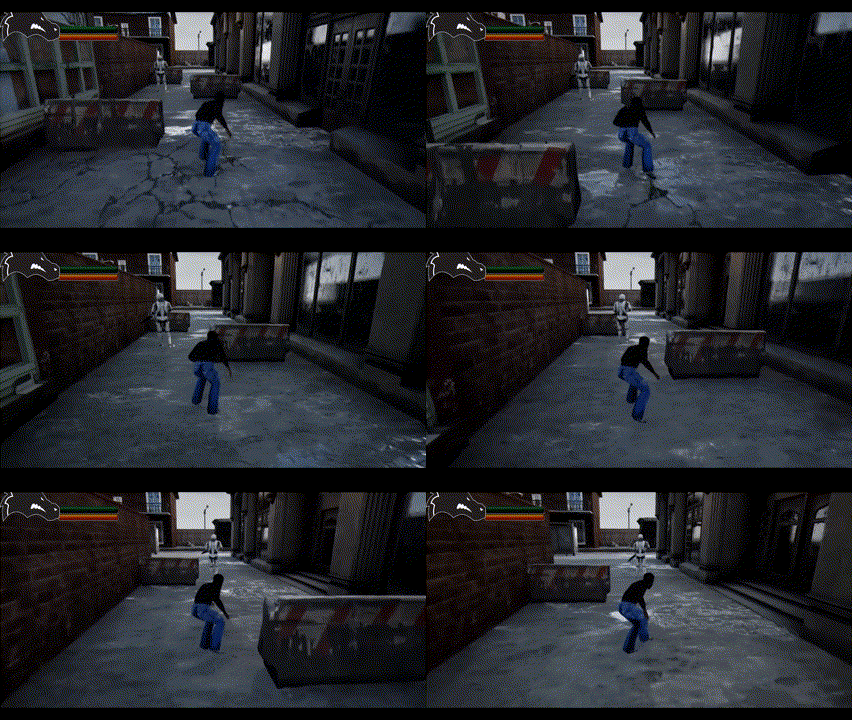
“Radium” gameplay is designed so that player follow a predefined path. However, to enrich the gameplay and provide a sense of exploration and personalization, optional side quests are integrated. The main character “Niles” can only make full use of his abilities when wearing his combat suit. If Niles is not wearing his suit, he is reduced to basic melee abilities.
I envision “Radium’” to be real time combat and character switching; similar to FFVII Remake. The narrative with this dynamic of gameplay comes through the character’s relationship with each other. Barks and banter dialogue can be used to convey this.
Using the dynamic of character switching can reveal each character bringing their own background, motives, and reactions to the narrative events. This multi-dimensional approach deepens the player’s understanding of the plot and world while connecting them with the characters on a deeper level. Real time combat sequences can be used to escalate tension, making players feel the urgency and danger of the situation, aligning their emotional state with that of the characters.

Quest Design
Starting with a hook sets the stage for the quest and gives players an immediate sense of the adventure ahead. Following this, a concise summary detailing the quest’s objectives and potential outcomes.
I used a quest flowchart as a visual representation of the quest’s progression and to show how different player choices will impact the narrative and gameplay. The section dedicated to special narrative content outlines how to strengthen the narrative through specific gameplay mechanics or unlockables tied to player choices.



Challenges & Lessons
As the solo creator, the most challenging part of this project was balancing combat with engaging world building. Many times players would need to fight an enemy without knowing why or the enemies relation to another character. To resolve this, I had to rewrite parts of the narrative and re-design quests to give the player a better understanding of the characters and enemies.